
Description
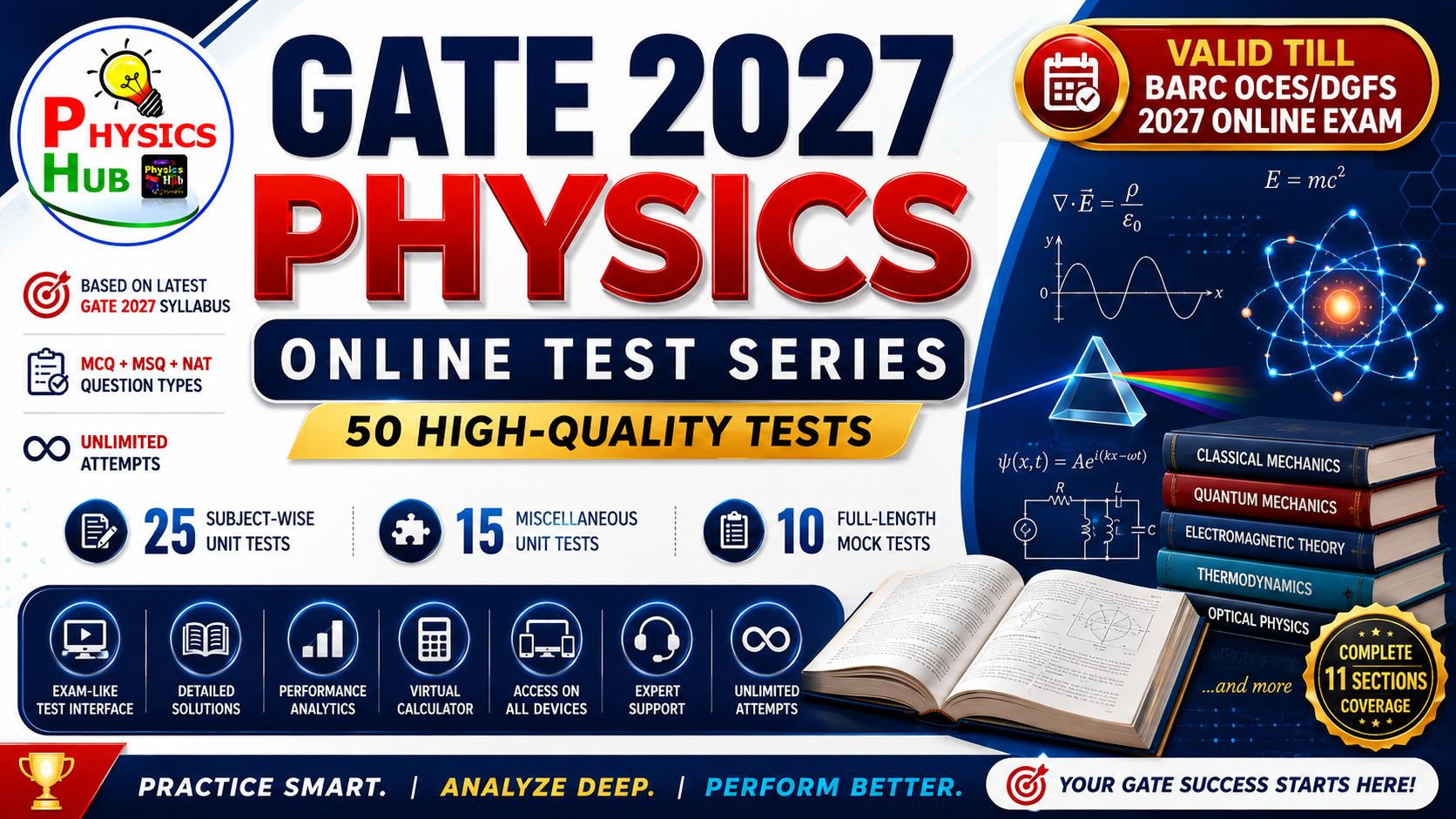
The GATE 2027 Physics Online Test Series by Physics Hub is scientifically designed according to the latest GATE 2027 Physics syllabus and examination pattern. The test series is structured to strengthen conceptual understanding, numerical problem-solving ability, analytical thinking, accuracy, speed, and examination temperament through 50 high-quality tests, including subject-wise tests, mixed-topic tests, and full-length mock examinations.
📌 Course Validity: Till BARC OCES/DGFS 2027 Online Examination
The series provides comprehensive practice across all 11 sections of the GATE 2027 Physics (PH) syllabus, including the newly specified Measurements and Error Analysis and Optical Physics sections. The official GATE 2027 Physics syllabus is organized into 11 sections covering Measurements and Error Analysis, Mathematical Physics, Classical Mechanics, Thermodynamics and Statistical Mechanics, Electromagnetic Theory, Optical Physics, Quantum Mechanics, Atomic and Molecular Physics, Solid State Physics, Nuclear and Particle Physics, and Electronics.
The test series will remain valid till the BARC OCES/DGFS 2027 Online Examination, providing aspirants with extended practice and revision opportunities beyond the GATE examination.
🧮 GATE 2027 Physics Online Test Series — Test Details
|
Test Category |
No. of Tests |
Purpose / Coverage |
Test Format |
|
Subject-wise Unit Tests |
25 |
In-depth practice of individual topics and syllabus units across all 11 sections of GATE 2027 Physics |
MCQ + MSQ + NAT |
|
Miscellaneous Unit Tests |
15 |
Mixed-topic tests to assess conceptual connections, analytical ability and problem-solving skills |
MCQ + MSQ + NAT |
|
Full-Length Mock Tests |
10 |
Complete GATE-level examination simulation with mixed topics and exam-oriented questions |
MCQ + MSQ + NAT |
|
🎯 Total Tests |
50 |
Complete syllabus practice + mixed-topic practice + full-length examination simulation |
MCQ + MSQ + NAT |
📋 Full-Length Mock Test Pattern
|
Parameter |
Details |
|
Number of Mock Tests |
10 |
|
Duration |
3 Hours |
|
Total Questions |
65 |
|
Total Marks |
100 |
|
Question Types |
MCQ, MSQ & NAT |
|
Calculator |
Virtual Scientific Calculator |
|
Difficulty Level |
GATE Examination Level |
|
Coverage |
Complete GATE 2027 Physics Syllabus |
|
Purpose |
Real-exam simulation, time management, accuracy & question-selection practice |
📖 Test Structure & Syllabus Coverage
The test series comprehensively covers all 11 sections of the GATE 2027 Physics syllabus.
|
Section 1: |
Measurements and Error Analysis |
|
Units and dimensions, dimensional analysis; least count, significant figures; Methods of measurement and error analysis for physical quantities associated with various measurements; 2-probe and 4-probe methods for resistance measurement; Grounding for electrical circuits, Ground loops; Design of DC power supply, Signal processing through lock-in amplifiers. |
|
|
Section 2: |
Mathematical Physics |
|
Linear vector spaces: basis, orthogonality and completeness; matrices: similarity transformations, diagonalization, eigenvalues and eigen vectors; linear differential equations: simple applications of first and second order linear differential equations and solutions; complex analysis: Cauchy-Riemann conditions, Cauchy's theorem, singularities, residue theorem and applications; Fourier analysis; tensors: tensor transformations, covariant and contravariant tensors. |
|
|
Section 3: |
Classical Mechanics |
|
D'Alembert's principle, Euler-Lagrange equation, Hamilton's principle, calculus of variations; symmetry and conservation laws; central force motion: Kepler problem; small oscillations: coupled oscillations and normal modes; rigid body dynamics: inertia tensor, orthogonal transformations, Euler angles, torque free motion of a symmetric top; Hamiltonian and Hamilton's equations of motion; canonical transformations: Poisson bracket. Special theory of relativity: Lorentz transformations, relativistic kinematics, mass-energy equivalence. |
|
|
Section 4: |
Thermodynamics and Statistical Mechanics |
|
Laws of thermodynamics; macrostates and microstates; phase space; ensembles; partition function, free energy, calculation of thermodynamic quantities; classical and quantum statistics; degenerate Fermi gas; black body radiation and Planck's distribution law; Bose-Einstein condensation; first and second order phase transitions, phase equilibria, critical phenomena. |
|
|
Section 5: |
Electromagnetic theory |
|
Solutions of electrostatic and magnetostatic problems including boundary value problems; method of images; separation of variables; dielectrics and conductors; magnetic materials; multipole expansion; Maxwell's equations; scalar and vector potentials; Coulomb and Lorentz gauges; electromagnetic waves in free space, non-conducting and conducting media; reflection and transmission at normal and oblique incidences; polarization of electromagnetic waves; Poynting vector, Poynting theorem, energy and momentum of electromagnetic waves. |
|
|
Section 6: |
Optical Physics |
|
Wave equation: plane and spherical waves, superposition of waves, standing waves, phase and group velocities; Interference: spatial and temporal coherence, dielectric films, Newton’s ring, multiple-beam interference, Michelson interferometer, Fabry-Perot interferometer and etalon; diffraction: Fresnel and Fraunhofer diffraction, rectangular and circular aperture, Rayleigh criterion of resolution, diffraction from double slit and many slits. dispersion by a grating; polarization: Jones vectors and matrices for linear, circular and elliptical polarization, birefringence, ray-transfer matrix for mirrors and lenses; lasers: Einstein coefficients, population inversion, two and three level laser systems. |
|
|
Section 7: |
Quantum Mechanics |
|
Basic ideas of quantum mechanics; uncertainty principle; linear vectors and operators in Hilbert space; time independent Schrodinger equation; one dimensional potentials: step potential, finite rectangular well, tunnelling from a potential barrier, particle in 1,2,3-dimensional box, particle in single and double delta function potentials, 1,2,3 dimensional harmonic oscillator: concept of degeneracy; central potentials; |
|
👤 Who Should Enrol?
This test series is ideally suited for:
• GATE 2027 Physics aspirants
• BARC OCES/DGFS Physics aspirants
• Students preparing for GATE + CSIR-NET
• Final-year B.Sc. Physics students
• M.Sc. Physics students
• Physics graduates preparing for competitive examinations
• Aspirants looking for intensive GATE-level test practice and performance evaluation
❓ Frequently Asked Questions (FAQs)
Q1. How many tests are included in the test series?
50 tests are included:
• 25 Subject-wise Unit Tests
• 15 Miscellaneous Unit Tests
• 10 Full-Length Mock Tests
Q2. Is the test series based on the latest GATE syllabus?
Yes. The test series is based on the official GATE 2027 Physics (PH) syllabus, which consists of 11 sections, including Measurements and Error Analysis and Optical Physics.
Q3. Can the tests be attempted multiple times?
Yes. Unlimited attempts are allowed.
Q4. Are detailed solutions provided?
Yes. Detailed, step-wise solutions are provided for the questions in the test series.
Q5. Does the test series cover the complete GATE 2027 Physics syllabus?
Yes. The test series is structured to provide comprehensive coverage of all 11 sections of the official GATE 2027 Physics syllabus.
Q6. Will this test series help with BARC OCES/DGFS preparation?
Yes. The tests provide extensive practice in conceptual understanding, numerical problem-solving and examination-oriented Physics, making them useful for BARC OCES/DGFS Physics preparation as well.
Q7. Is a virtual calculator available?
Yes. A virtual scientific calculator is available within the online test environment.
Q8. Are MCQ, MSQ and NAT questions included?
Yes. The test series incorporates MCQ, MSQ and NAT formats to provide comprehensive examination practice.
GATE 2027 Physics Online Test Series
Member Reviews
What our members are saying about this course
No testimonials yet.